
PlantQTLdb Assistant
Network Analysis with STRING
explore functional associations or physical interaction evidence between candidate proteins
Requires Research mode
Open PlantQTLdb AssistantWhen to use it
Ask whether 2–50 genes or proteins from one species have supported relationships. Input IDs are mapped to STRING proteins; ambiguous mappings require clarification rather than a guessed match.
How to ask and what you receive
Functional association network
Use STRING to analyze the functional association network of Arabidopsis genes AT1G01010 and AT1G01020what you receive
A STRING result card containing a network, mapped nodes and association scores, with JSON, CSV and SVG downloads. Verification returned two nodes and one edge for this input.
Request the physical network
Use STRING to analyze the physical interaction network of Arabidopsis genes AT1G01010 and AT1G01020what you receive
The physical-network query for the same mapped proteins. It may contain fewer edges or none; a functional-network edge does not guarantee a physical-network edge.
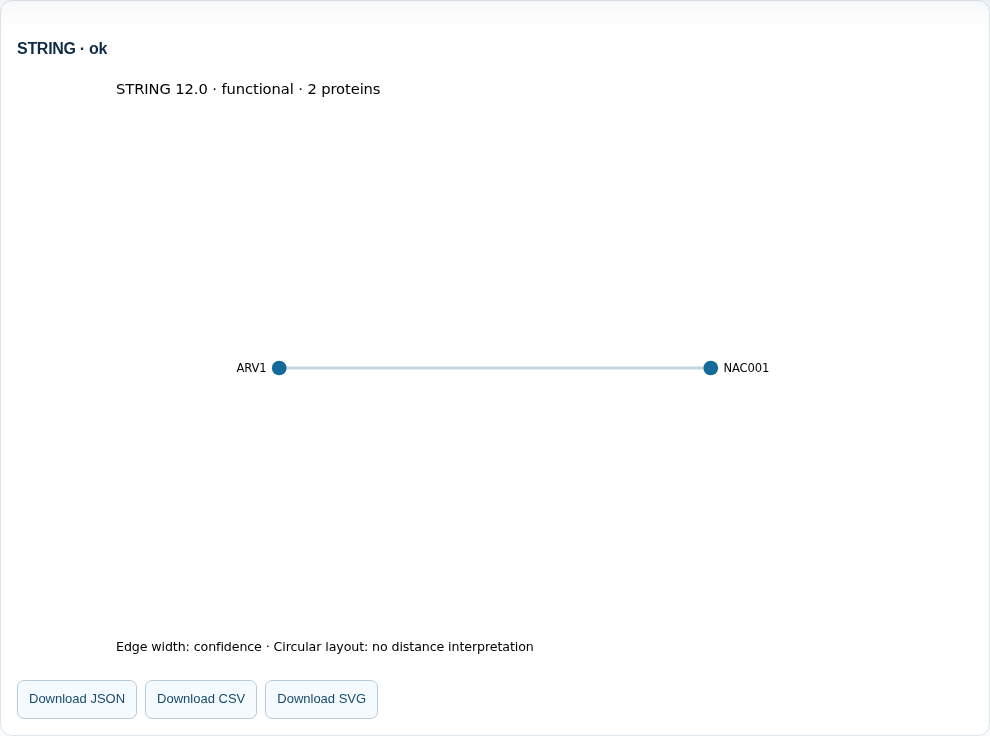
Interpret the diagram
- Functional association
- Evidence that proteins participate in related biological processes; not necessarily direct binding.
- Physical network
- Physical-interaction evidence as represented by STRING, which can include membership in a complex; do not assume every edge proves direct binding.
- Score and layout
- Edge width follows confidence. The default threshold is 700/1000. Circular node positions have no biological distance meaning.
If the expected card does not appear
Confirm Research mode and resend the question. A literature answer without a STRING card does not demonstrate that the STRING analysis ran.
For a successful query with no edges, inspect mapping and the score threshold. Missing IDs or absent edges are not proof of no interaction. The tool uses STRING 12.0, does not automatically add neighboring proteins and returns at most 1,500 edges.