
PlantQTLdb Assistant
Gene Structure and Sequence Extraction
view all annotated transcripts and extract reference DNA, cDNA, CDS, protein or promoter sequences
Requires Research mode
Open PlantQTLdb AssistantWhen to use it
Inspect exon and coding-region differences between transcripts, retrieve an exact reference interval or prepare a sequence for another analysis. This tool reads installed reference annotations; it does not predict a new gene structure.
How to ask and what you receive
View every transcript
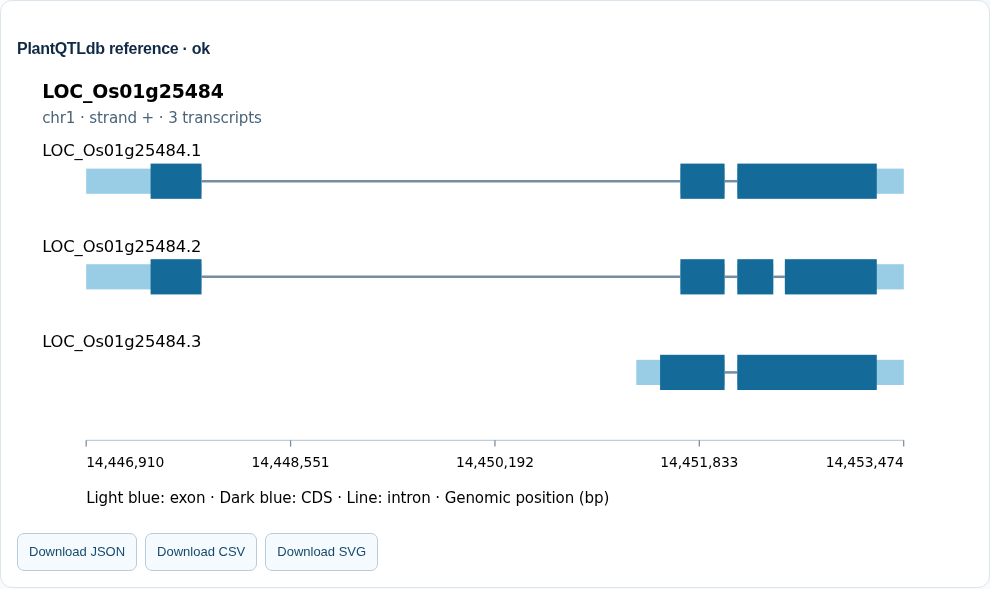
Show the gene structure of rice LOC_Os01g25484what you receive
A shared-coordinate diagram containing all returned transcripts, plus exon, intron and CDS summaries. The verified rice example displayed three transcripts without a transcript selector. Download JSON, CSV or the full SVG diagram.
Extract an exact interval
Extract the genomic sequence of Arabidopsis TAIR10 chr1:10000-10200what you receive
A 201-base reference sequence, with its chromosome, interval, assembly and FASTA download. Both interval endpoints are included.
Extract one transcript's CDS
Extract the CDS sequence of Arabidopsis AT1G01010, transcript_id=AT1G01010.1what you receive
The joined CDS sequence for the named transcript in transcriptional orientation, with a sequence preview and complete FASTA download.
Input and coordinate rules
- Include one species and one gene or interval. For a multi-transcript gene, cDNA, CDS, protein and promoter extraction may require an explicit transcript_id; use an identifier returned by the structure query.
- For a promoter, ask for the upstream length, for example 2 kb, and specify the transcript when necessary. Upstream follows transcription direction, including on the negative strand.
- Coordinates are 1-based and inclusive. Negative-strand extracted sequences are reverse-complemented into transcriptional orientation.
- Sequences are limited to 20 kb per extraction and promoters to 10 kb. Out-of-range intervals and incompatible reference versions produce an explanation rather than silent coordinate changes.
Interpretation and species limits
Exon blocks and intron connectors represent stored annotation. CDS marks the coding subset; transcript differences are not newly observed splice events. Protein translation requires a suitable complete reading frame and can be rejected for internal stops or an unspecified organelle genetic code.
The new reference tool is currently disabled for sorghum and tomato because their installed reference versions have not been reconciled with website coordinate labels. The response explains that no extraction was performed.